Showing posts with label Archery. Show all posts

Tuesday, 4 September 2012

Week 9 - 4 September 2012: Legend Streamline Recurve Bag

Legend Streamline Recurve Bag very nicely priced at £42.50 from Ten Ring Archery


Looking for your first recurve case, but would rather spend your money on your bow than a bag? Archery specific bags can cost a fortune so why waste your money on a necessity that wouldn't improve your shooting. I recently came across this simple, but effective recurve bag which is very reasonably priced (considering the price of others I have seen). 

The Legend Streamline is 69 cm tall, 20 cm wide and 20 cm deep and will fit risers up to 25". It comes complete with arrow tube and typically with a removable nylon sleeve for limbs and riser (check with individual sellers) and front accessories pocket. Comes in black, blue, silver and red and contains polyethylene shock absorbing foam for added protection. The bag can be worn as a rucksack via back straps or carried via side handles.

If you want to spend even less, you can buy soft recurve cases. However, these often lack an arrow tube or any substantial padding or protection and are often used by clubs just as a means of storage.  


Tuesday, 21 August 2012

Zombie Apocalypse - Some Archery fun

I came across another archers blog (return to archery) and found the coolest thing ever! I need not say much more than Zombie targets!!!


Picture from return to archery

Clout and field shoots are fun but trickier to arrange and at our club we are often thinking about how to make target archery more fun (especially for the juniors). 

Although designed and sold for gun shooting, I came across these fantastic alternative targets and after visiting the dealers web site found out they were even cooler than just zombie pictures. After all, any one can type zombie into Google and print out some target faces. These are targets with a difference - they come with "VisoColor" technology. This basically means that kill shots produce a green circle (where your arrow hits), yellows are wound shots and white circles indicate a miss or accidental hostage shot.    

The targets can be brought here and they come in a variety of different designs at 18" by 12". A mix pack of 6 will set you back just under $10

I have been told many times that the purpose of archery is to prepare for that impending zombie apocalypse.... so for all the male archers here you go :P.


Tuesday, 14 August 2012

Week 8 - 14 August 2012: Visionary 8 x 21 Binoculars


Visionary 8 x 21 Binoculars £15.66 down from £19.73!  Merlin Archery 

If your shooting target or hunting binoculars are extremely handy for any serious archer. If you can't afford a standalone scope this is the next best thing. These  binoculars will do the job and are currently on sale at Merlin Archery for one of the best prices I can find (new) on the internet. These binoculars are rubber covered with 8 x magnification coated lenses, a 21mm diameter objective and 7° field of view. This product typically comes with neck chord/strap and case and 10 year grantee, but please check with Merlin Archery for exact specifications. It weighs 170g, measures 90x90x40 mm and can be used for other things apart from archery so is great value for money


Sunday, 12 August 2012

Why you should check carbon arrows before you shoot....

Went to the club for this weekends shoot & any chances of shooting a personal best went out the window when I had to claim a miss as my arrow exploded 3 dozen in!


I shot my arrow as normal and although it sounded a little odd I had no idea what had just happened until I went up to score my arrows. There was a little rattle, as if my long rod was loose, but apart from that I was none the wiser. Half way up the field I heard my name being called  from near the shooting line and was amazed to see the nock end of my arrow being held up.... but with the rest of the arrow missing! The rest of the arrow had made it almost to the target - shame I would have loved to claim a score with half an arrow! 

As far as I am aware the arrow hasn't been shot into the wood bit of the target, though as it would have been shot from my new bow, it may have been buried in the ground during sight marking testing. The bow appears to be fine and there are no marks to suggest that I shot the arrow wrong/ie not on launcher etc. It is amazing to think that just shooting an arrow that is week (for what ever reason) can snap it in two, with even the metal on the inside being bent!

A little note if this happens to you - don't touch the broken bits as the carbon arrows can give you very nasty splinters.

Just have to hope that this doesn't happen at the competition next week!

Monday, 6 August 2012

Week 7 - 6 August 2012: PSE - RTS - Rally 2012


I have added this to my weekly bargains because it is such a versatile compound. Great for new archers wishing to try their hand at compound and handy for fast growing juniors! The RTS rally gets its versatility from its wide range of draw lengths possible. From a little 18" draw length all the way to a lengthy 31" makes this bow accessible to most, if not all,  archers. 

Another great thing about this compound is the wide range of poundage options and is available in 15-30#, 18-60# and 20#70. Just  remember the bow will perform best at its max and 70# is above the legal UK target. Also only available in mossy oak break-up infinity camo - so check you competition rules before buying.  

A brace height of 7.5" makes this a very forgiving bow, resulting in less arm slaps - always nice. The bow also comes with lots of extras to get you going including Gemini sight, quick shot whisker biscuit, mongoose quiver, peep sight, nock loop and peep wheel.


Thursday, 2 August 2012

Olympic Archery Diary Women finals - 2 August 2012

Today we saw the women 1/8 eliminators from 9am and in this competition the archers shoot 3 arrows each set and the highest scorer gets 2 points, or 1 point each for a draw. The winner is the first archer to a total of 6 points. Two Korean women, Lee Sung Jin and KI Bo Bae, thrashed their opponents 6-0, Urantungala Bishindee and Hayakawa Ren, respectively (Mongolia and Japan). Schuh Berengere (France) and Perova Ksenia (Russia) won their matches against Choi Hyeonju (Korea) and Rochmawati Ika Yuilana (Indonesia), respectively,  by a single point. Chen Ming (China), Tan Ya-Ting (Taipei), Kaine Miki (Japan) and Christianesen Carina (Denmark) were knocked out.

The quarterfinals began at 2pm and with no close matches Lroig Khatuna (USA), KI Bo Bae, Roman Aida (Mexico) and Avitia Mariana (Mexico) soared easily through to the semifinals. These 4 archers then battled it out for the 3 medals. Avitia Mariana won bronze in her match against Lorig Kahatuna due to the Americas unfortunates arrows, even hitting a 6 inthis bronze medal match! The pressure must have also gotten to Roman Aida as she also shot a 6, leaving her with a silver medal and her opponent, KI Bo Bae with the gold. 

Final results = KI Bo Bae - Gold, Roman Aida - Silver and Avitia Mariana Bronze   

For results see the Olympic archery official page 


Monday, 30 July 2012

Week 6 -30 July - Bear Archery Deluxe Longbow Case


At £61.20 this would make a great present for your fellow longbow archer. Don't let the cat chew the strings, keep your bow safe with this deluxe Bear Archery case! Zip up case with sturdy handle and identification window. Nylon exterior case with internal padding. This case will fit all Bear longbows and many other longbow types, with outer dimensions of approx 69" by 5". Also on sale is a similar case suitable for recurve bows


Olympic Archery Diary Day 3 - 29 July 2012


The 1/8 eliminators started at 9pm and resulted in GB, India, Italy and the Ukraine knocked out in the early stages of the competition. Although Italy and Denmark progressed to the quarter finals by a one point win, Japan and Russia beat their opponents Ukraine and GB, respectively, with several points to spare. The Ukraine shot poorly, but had been unlucky with their clothing after being told they could not shoot with a sleeveless kit and their alternative kit had too many logos on, resulting in lots of tape to cover them up! It just wasn't  their day, as the Ukrainians went on to shoot a 3 and a 4 scoring arrows, the lowest I think we've seen so far.   

After shooting well in the 1/8 eliminators Denmark followed with a poor round in the quarter finals, loosing to Korea 11 points behind. Japan and China made it into the semi finals by beating their competitors Mexico and the US, respectively. The closest match of the quarter finals was Taipei vs Russia where a 3 arrow shoot off was required, but Russia shot well under pressure to take the shoot off by 2 points

In the semi finals Japan and Russia lost their matches leaving them to go head to head for the bronze medal. Russia lost out on their chance for a medal by 2 points, earning the Japanese team their bronze medal.

The finals saw China against Korea. Although the final result was no surprise, with Korea taking gold and China silver, the match was close, with Korea winning gold by a single point keeping the audience poised down to the last arrow. This is the 7th consecutive gold medal for the women's Korean team and China also bagged a silver medal at the 2008 Beijing Olympics. 

Final Results = Korea - Gold, China - Silver, Japan - Bronze

For up-to-date and live results see the Olympic archery results page 


Sunday, 29 July 2012

Olympic Archery Diary Day 2 - 28 July 2012

On Saturday the men team events took place, with medals awarded later on that day. The 1/8 eliminators kicked off at 9 am and rapidly saw GB, Taipei and Malaysia knocked out. India also narrowly lost out on a place in the quarterfinals to Japan after initially drawing and Japan taking the lead after a 3 arrow shoot off.  

After qualifying for the quarterfinals following a 3 arrow shoot off, Japan lost out to any further progression after loosing to America by one point, despite Americas initial slow start. Korea won their place in the semi finals against Ukraine and shot the highest scoring match of the day. In the third quarterfinal match China was off to a good start with a 10, but Italy won the patch 4 points ahead. Last of the quarterfinals, Mexico vs France and this was the most surprising event of these 4 matches. France just couldn't keep their cool and an arrow of 6 within the first 3 arrows was a bad start and Mexico shot well scoring 220 to give them a place in the semi finals.   

The biggest surprise of the day was Korea's loss to the USA, meaning no gold medal for Korea in the men team event! After Mexico's defeat by the Italy, they went on to play Korea for the bronze medal. The Korean team held it together, despite their earlier defeat, and went on to win the bronze medal.  

This left the USA vs Italy for the finals. Italy held a two end lead and then the USA caught up resulting in a nail biting ending. Final scores of 218 and 219 resulted in a 1 point win for Italy! 

End result : Italy - Gold, USA - Silver, Korea - Bronze

The competitions were close and a few surprising disappointing shoots from the Korean's and France. Throughout the day there were 5 dead center shoots and shooting out 5 cameras! A handy Italian trick was to add a piece of string to your bow to allow you to see the direction of the wind - but who knows what their secret to success is.

For all official results see the Olympic schedule 

Friday, 27 July 2012

Olympic Archery Diary Day 1 27 July 2012

On the day of the Olympic ceremony archers took their place on the line to shoot the  ranking round. Unfortunately, this initial round was not open to the public and there have been reports of disappointed spectators being turned away after purchase of fake tickets (liveolympictickets.com, reported as one of these fraudulent sited).

However, media coverage of today's event is keeping the excited friends, families and fans up-to-date one the latest nail biting events so far. Although it is only the qualifying rounds Im Dong-hyun has already broken a world record by scoring 696 with 72 arrows, beating his previous record of 693. One record wasn't enough apparently, and the Korean team (Im Dong-hyun, Kim Budmin and Oh Jin-hyek) went on to score 2087 from 216 arrows, breaking yet another world record!

It is then no surprise that the 3 Korean competitors currently sit at the top of the men individual table. Also in the top 10 men individual category are archers from GB, Japan, France, China, Canada and the USA. In the team events Korea is currently followed by France, China, USA and Japan, with India in 12 (last) place.  


For the individual women archery event Korea again are top, taking both first and second position. Other countries with arechers in the women individual event include Taipei, USA, Japan, Denmark, India and Mexico. Again for the women team event Korea are top and are followed by the USA, Taipei, Mexico and Japan, to make up the top 5 countries in the archery women team event.   

With 2 new records shot in one day, viewers will be glued to their TV in anticipation of greater scores as the competition mounts. Stay tuned to see if Korea continue to lead the way. For full rankings and results take a look at the London2012 web site


Tuesday, 24 July 2012

Unusual Archery types - Popinjay

There are a few unusual, slightly odd, less practised, less practical, forms of archery types that I didn't include in my overview of different archery types. I felt that some of these archery types, such as popinjay, flight and horseback archery deserved their own blog. However, don't expect to be able to pop down to your local archery club to practice these types of archery, some are just far to impractical for most archery grounds and possibly not for the feint hearted!


What is popinjay?


Merlin Archery 


Although uncommon, the popinjay is a fun and different way to enjoy archery and is also known as Papingo. The aim is to shoot vertically at a bird (targets, not real birds!!!) from a post often 100 ft high. Somewhat similar to practising shooting birds, but using targets like field archery, so not quite like hunting where your prey will actually move (thankfully!). Although, you can imagine this was a sport derived from something a little harder, such as actually shooting at live birds. The winner is the first to get he bird of its perch. 

Popinjay can be shot using all bow types (compound, recurve and longbow) but is not just for archers, this round is also enjoyed by gun and crossbow shooters. 

It is a great alternative to target archery, though can be somewhat labour-intensive getting the bird targets up on their posts in the first place! Depending on the event the birds can be made from various materials including wood, pipe cleaners and more recently a synthetic material, with various feather additions. 


History

Popinjay is another word for parrot, from the French papegai.  In Germany, bird shooting from a perch is known as Vogelschießen and done typically with a rifle (also in Denmark) or crossbow, and in Canada popinjay is known simply as pole archery. Archery popinjay is a popular round in Belgium (more so than any other country), but sights and any mechanical aids are not permitted (such as compound and cross bows). Kilwinning is England's oldest archery club and has run this since the 15th C, with the first competition record in 1483. Kilwinning is one of the few, possibly only, UK club known to run popinjay competitions.


There are some rumours of a popinjay festival that takes place every year on the first Sunday in May. However, I'm not sure how often the winner gets called "Captain popinjay" or if this is some sort of internet joke - but pictures are most welcome!


Rules

Rules tend to vary as this is such a rare form of archery. Archers are required to use blunt ended arrows (for safety) and to ensure a means of keeping your arrow on your rest when shooting upwards. 


Merlin Archery 

Kilwinning Annual Open and Club, "dingin doun the doo" Competition, Scotland 

A butt shoot can be used to determine the order of shooting (6 dozen arrows at 30 yds 3 ring, 9" target) and the first to shoot the bird of its perch is the winner. The birds wings are loosened and awards are given to those knocking off the wings. At this shoot archers shoot at one bird target 126 ft at the top of the cathedral from the cathedral step. 

GNAS Popinjay 

A popinjay round will include One cock, four hens and at least 24 chicks, with the highest (the cock) set at 90 ft. The size of all targets are 1.5" long and 3/4" wide and 3-12" tall, depending on the target. Chick perches should be 6" long and with 4" minimum separation, Hen perches a minimum of 8" apart and cock bird at least 30" above the top row. 5 points are given for hitting the cock, 3 for a hen and one point for a chick. For safety rigging around the targets should be covered with sponge/rubber and there must be a sheltered space for archers waiting to shoot (or be a good distance away).

Canadian Pole Shooting


The archer with the most points after one hour is the winner. Points are achieved by hitting birds on the 5 rows + 1 King Bird at the tip, with higher birds worth more points. Single birds located on rows 1-3 are worth 1 point, Kullas birds on row 4 worth 2 points and side birds on row 5 worth 3 points. The King bird at the top is worth the maximum, 4 points. The name of "King shooter" for the year is, you guessed it, the first archer to hit the king bird off the top.


Canadian Horizontal Indoor Perch

Shot from a distance of 65 ft at a horizontal perch indoors, generally without a sight. A high bird is worth 4 points, side bird (x2) worth 3, Kalle bird (x2) 2 and 30 small birds worth the least at one point each.  

Where to shoot

5th August 2012 - Medieval Merriment Popinjay competition, Castle Lodge, West Yorkshire, UK, WF8 1QH, £5 entry fee.  


Archery clubs throughout Belgium and Canada.

-------------------------------------------------
Blogs on Horseback Archery and Flight archery coming soon!

Monday, 23 July 2012

Week 5 - 23 July 2012 - BowSports Deluxe Quiver

Bow Sports Delux Quiver - On offer at £16.99! Bow Sports

If you'r after a decent looking quiver without breaking the bank then this could be the bargain you'r looking for.  With a good range of colours (including red, blue, green, black, orange, pink, burgundy and purple) in both left and right handed options there's sure to be a quiver to match your colour scheme. This would make an ideal first quiver that does the job with 4 tubes and three pockets at an affordable price. * belt not provided

Monday, 16 July 2012

Top 10 tips - Preparing for your archery competition

This is a nice little check list you may find helpful when preparing your equipment the day before your competition. Top archers are able to shoot perfectly unaffected by distractions, but the last thing you want is to be worrying about something you forgot to pack or look up the day before! Below is a series of things to double check to make your competition stress free.

This isn't a blog about how to prepare your technique and coach your self for a tournament - that's a topic I'll save for another time! 


1. Know where the competition is and the time

Double check your shooting time with the target lists that are sent around. Take maps and directions along with the address and postcode for Sat Navs. Google street view the location so that you can recognize it easily and give plenty of travel time to allow for set up and relaxation before shooting starts. 


2. Take spare equipment

Essential spares include...

Fletches
Knocks
Piles
Complete arrows (minimum of one fully made arrow in practice another whole set of 6 arrows is best)
Arrow rest (recurve)
Tabs (recurve)
String (recurve)
Finger/wrist sling
Glasses/contact lenses for those of us that need them!

Ideally you would take two of everything you have - however, this is impractical & expensive for most archers! 

Other spares to consider include...

For compound archers -
     Scope lens
     Spirit level
     Release aid  
     D-loop

For recurve archers - 
     Knocking points
     Button  

Of course tools to fix your equipment is also helpful - often though you will find other archers with the right tools. 

Basic tool kits for archers include... 

Allenkeys 
Screwdrivers 
String wax 
Fletching rig 
Fletching glue 
Bracing height gauge 
Screw (to get out those stubborn broken knocks) 
Knock pliers
Tape (you never know when desperation calls upon creativity!)

Don't forget to call equipment failure if you need to change something (ie like your arrow rest falls off!!!). 


3. Be prepared with a range of Clothing

Weather can change rapidly (especially if it's anything like this years non existent UK summer) and it is idea to keep an "archery clothing set" in your bag at all times. Some ideas include...

Hat 
Sunscreen
Large umbrella
Sunglasses
Towel
Hair band for those windy days
Flat, even boots that you can shoot in any weather/amount of mud
Tight fitting T-Shirt and jumper (pref club cloths/colours)
Trousers that aren't camo colours or jeans (check your local/country rules)


4. Supplies


Don't rely on competition food. Take your own food that is easy to eat in a field, quick to eat and non sticky. Take water and energy drinks/coffee if this is your thing. Also painkillers can be handy if your unlucky enough to need them!


5. Creature comforts 


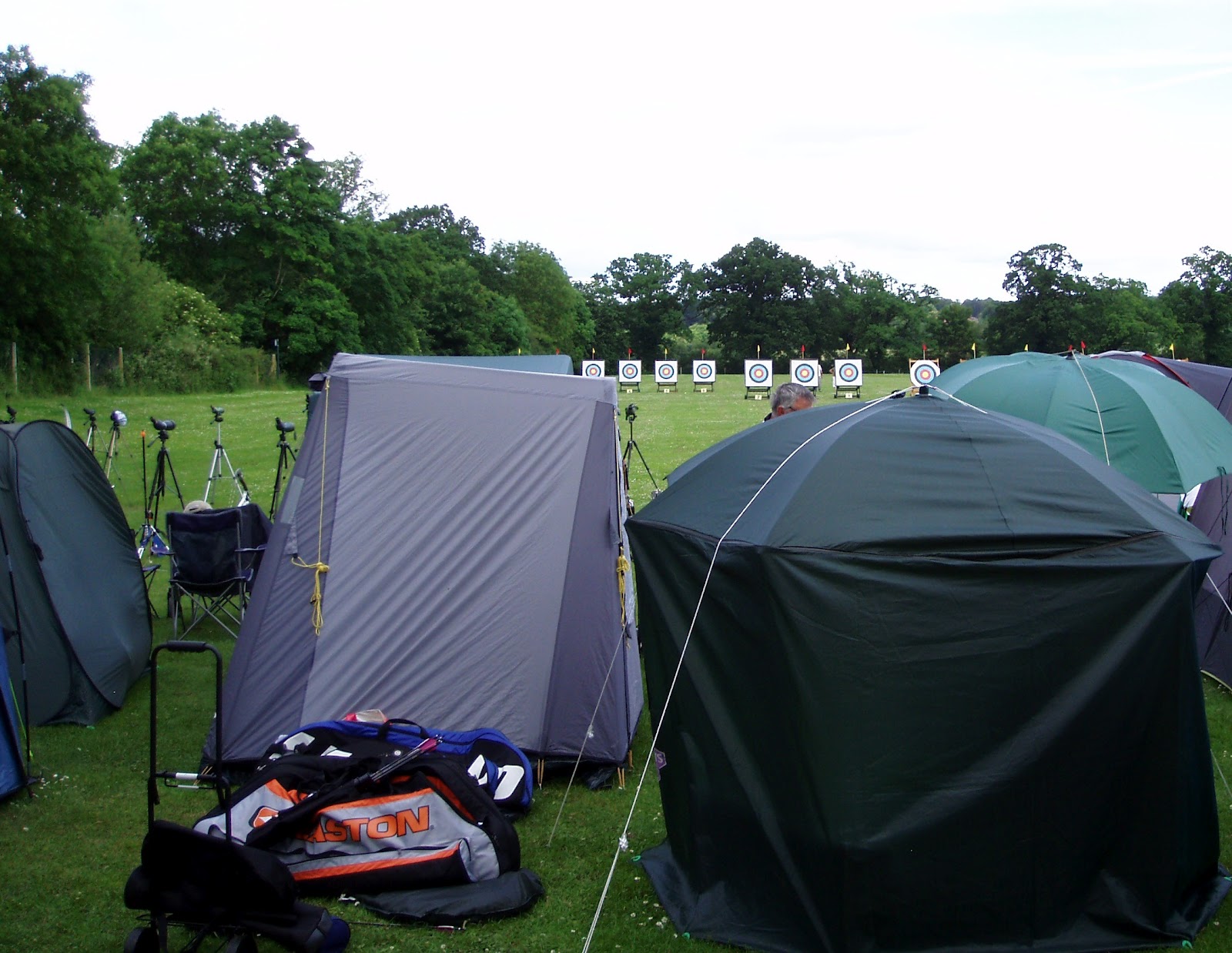
At the first competition I attended the first thing I noticed was all the tents! There were tents every where - you couldn't even see the registration table and had to smell your way to the food table. Then within a few competitions I quite rapidly realized how important they were. Tents provided the much needed shelter between showers (or even from the sun on those rare hot days) and give you somewhere to set up your bow out of the mud/keep your bow dry until you shoot. 

A ground sheet to go with the tent is some what obvious - but still handy.

A seat is also becoming a necessity for me. Archery isn't the most tiring of sports, but save your energy for shooting! Somewhat over thinking, but a seat that is mildly water proof (ie not cloth) might be a better buy or even one you can carry as a rucksack - as it's not as if we already have enough stuff to lug around! 

6. Know the rules

Tournament rules is a topic I'll save for another blog, but it is important to know some of the rules after all if you are new to archery the last thing you want is to be disqualified before you start!

Some key beginner tips include...

Clothing - there are rules on colours (ie no cammo and jeans), sponsor apparel and club colours that judges can choose  to enforce.

No touchy theee arrows! - point at your arrows as you call out your score, but don't touch until all scoring has been done. This is to make sure people don't push the arrow over into a higher scoring zone if it is close to the line. Also you can't write down your own scores.

Call fast if - an arrow is hanging off the target, someone/something is across the shooting line or someone has drawn their bow on the shooting line but has no arrow knocked. 

Get a judge if a score is incorrectly written down. Adding mistakes can be crossed out, but actual arrow score mistakes have to be checked and initialed by a judge.


On the day a judge will explain the whistles and how many arrows will be shot at a time along with any other key info - so insure you are there early to listen to this.


7. Know your round

Double check the day before what round you entered and how many arrows at what distance you will be shooting. If several archers and you begin to think the distance is wrong then say sooner than later as you can't start your shoot again. 

Also worth checking the county and national records for your round. You never know, you might just shoot that supper round & you need to point this out to the judge on the day.


8. Check your sight marks

Perhaps more important for new archers, but check your sight marks a few days before the competition. You never know what changes you have made to your bow you forgot about since you last got some sight marks and your technique may have changed.

Unless something is broken, don't fiddle with your bow after you got your sight marks!


9. Identification and membership details


If you wish to claim any records or your six gold end (for example) you will need to show your GNAS membership card (UK). Judges can also ask for membership details at any point throughout a competition so always have this handy.


10. Other helpful equipment

There were a few other helpful things I thought of but couldn't justify them having their own number so here is a random selection of tips...

Foot pins (daisy's get squished)

Scope to check your arrows as you shoot them 

Calculator in case you are the addddeeruppper :(

Pen 

Plastic bag to keep scores dry


Please feel free to leave a comment with any of your helpful competition preparations no matter how strange and crazy (tho not technique related as I will cover that another time).


Saturday, 14 July 2012

Week 4 - 9 July 2012 - Shibuya Ultima CP Carbon Sight - Compound - Left Handed


Looking for a great left handed compound sight? - This ultra light carbon sight, weighing only 230g, currently has 14% off its typical price. As well as being super light, the carbon components absorb more energy reducing movement preventing parts becoming loose. Slightly out of the price range of most beginners, but a recognized manufacture of great sights is a bargain for mid level archers looking to upgrade.

Thursday, 5 July 2012

Week 3 - 2 July 2012 - Samick Element Stabiliser - great stabiliser for beginner to mid level archers.

Samick Element Stabiliser £40.68, down from £58.91! Merlin archery

This weeks bargain is the Samick element stabiliser. Although stabilisers are not essential for beginners, if you do have a spare bit of cash then this is a great investment. For most archers, especially those who don't often compete or have only shot for a few seasons, there is no need to spend a fortune on a stabiliser. The cheapest one you can get will make the world of difference, if you have a decent technique. For beginners, I wouldn't normally recommend such an extravagent spend on a stabiliser, but I feel with 31% off this is a great price and worth consideration. Although the weights arent included in this price, you can attach some for customisation. 


Thursday, 28 June 2012

Beginners guide - Essential overview to different archery shooting types


For new archers wondering what different shooting types there are, I have drawn up a helpful outline below. 


Want to read about some of the more unusual shooting types? Take a look at Poppinjay

Target


Target archery is as simple as the name implies, it is shooting your arrows at a target. Target archery is the only category to be included as an Olympic sport. All bow types can be shot at a target; this includes recurve, compound and longbow.    

The target is circular with two rings of gold, red, blue, black and white emanating from the centre. Arrows shot closer to the centre are highest scoring, but the size of the target face varies at different distances and rounds and scoring imperial rounds differs to that of metric rounds. There is a multitude of target rounds (which I will outline in another blog) and these are different in their distances, target face size and number of arrows.

The max-required distance for female archers is 80 yards, but is 100 yards for men. Target archery can be shot throughout the year utilising both indoor and outdoor ranges. Tournaments are held regularly and there are often dress regulations (no camouflage or jeans for example). There are various medals to be one including the traditional gold, silver and bronze medals along with prizes for hitting particular colours at certain marked positions. Men and women compete separately as do the different bow types and juniors (under 12, under 14, under 16 and under 18).

 Field


Field archery is often shot with a wooded area (rather than a field!) and is considered a greater challenge compared to target archery. Field archery can also be exciting as the shoots are varied and there is a great challenge in not knowing exactly what to expect.

Targets are put at a maximum of 80 yards (often much closer) and the targets can be marked (with their distance) or unmarked. Target faces vary and often animal face targets are used and scoring can include both target hits and hits to a particular zone on a target. Targets can vary in size and some even 3D!

Field archery is considered difficult due to the archers need to judge the target distance within uneven ground, which is often dark due to tree tops blocking out sun light.

Field shoots are tightly regulated and controlled due to the dangers involved (compared to target archery). It can also be expensive due to the loss and damage of arrows as it can be difficult to hit the target.

Equipment used can be slightly different to target archery. For example, shorter stabilisers will make manoeuvring easier in heavily overgrown forests

Clout

Clout was initially introduced as a training aid and is now often shot for fun, that is not to say that it isn’t taken seriously! A Clout shoot is where the archers shoot their arrows at a flag and the closer the arrow to the flag the higher the score. Scoring is achieved using a bit of string attached to the flag that is divided into colours. The different colour sections denote the scoring group.

Two-way clout is where archers shoot at the flag and then shoot back to the starting flag. One-way is where archers shoot at just one flag.   

Although longbow, recurve and compound can all compete at tournaments in clout, compound archers have to take care to shoot down, rather than up in the air, at the flag for safety reasons.


Future blogs will concentrate further upon each shooting style. In these blogs  I aim to give an overview of scoring, tournaments, bow types and the attractions of each style.

Wednesday, 27 June 2012

Top 10 - Tips to find your first bow and accessories.


After passing your beginners course and a few months practice you want to move on from your starter wooden bow and buy your own. Take a look at the tips below to ensure you get a good bargain.

1)    Hire, if you can, for a few months from a local club.

2)    Don’t buy vastly heavier limbs straight away in aim to save money thinking you will eventually get used to them. It is a little annoying regularly replacing your limbs when you start archery, but injury, frustration and bad technique that develop from limbs too heavy will bring your score down.

3)    Buy second hand from other club members. You can also try the equipment for a couple of weeks before you buy, if they are willing.

4)    Keep an eye on ebay – seeing as you shouldn’t rush into your first bow, take your time and check ebay once a week for any suitable bargains. You will also get to know how much equipment is selling for and how much you should pay.

5)     Make sure you know what bows you would be interested and which ones would be suitable, so if you see a second hand one then you won’t miss out (for example you may miss bidding on ebay because you needed time finding out if the bow is suitable for you). 
                            
6)    The UK has the Archery interchange forum. There may be other forums dedicated to selling of second hand archery equipment in your country.  

7)    Some archery shops stock second hand equipment – but you often have to ring around as it is not always shown on their internet shops.

8)     Limb exchange and arrow “try out” is offered by companies in the UK such as Perris Archery, Silver Arrow Archery and Stylist Bows.

9)    Some shops such as Perris archery run workshops to allow you to try different bow types. This could be handy if you can’t chose between compound and recurve, especially as it is difficult to try a compound bow set up for someone else.

10)  Keep your costs down. There is no need to buy an expensive bow, technique is more important. In face I have seen many archers shoot amazing rounds with wooden club bows. Equipment that is right for you is more important than expensive equipment. 


Read my other blogs "Beginners guide- Archery Essentials getting started" and "Beginners guide - Things to consider before buying your first bow"


Tuesday, 26 June 2012

Week 2 - 25 June 2012 - Winact recurve limbs: Short 28# ideal for first bow!


Winact recurve limbs: Short 28# £120 down from £206.80! Merlin Archery


Described as having a smooth draw, especially for shorter archers you can't go wrong with the short Winact limbs. 28# is perfect for beginner archers, or even mid level junior archers. Normally priced over £200 these carbon limbs are out of the price range for beginners and juniors. However, with a 42% discount this is perfect for keen beginner archers and mid level archers looking for a bargain or a lower poundage to perfect their technique. 

Monday, 25 June 2012

Beginners guide - Things to consider before buying your first bow


So you’ve just passed your beginners course and you’re keen to buy your own kit? Owning your own bow is an exciting thought and browsing archery stores and looking what you want to buy is even more fun. Sadly, colour coordinating my arrows and kit has been so much fun I still haven’t decided and am just making do with what I have at the moment!

Something that I can’t emphasise more, is that it is not a great idea to go buy equipment straight away (unless you have endless money – if so please contact me :P). Below is a list of reasons that I hope will persuade you to hold back on spending your money for a minimum of 3 months (ideally 6) after completing your beginner course.

i)                  Lack of experience - you don’t know what equipment is available to buy and what is good.

ii)                While wait you can try out other people’s equipment.

iii)     As you are coached and you begin to feel what is right for you your technique will change dramatically over the first few months. This may impact the equipment you wish to buy (especially arrows as this will depend on your draw length).

iv)         Recurve is the best beginner bow, however for various reasons you may change to a compound bow 6 months later (such as being short like me! Or for hunting). Archers who shoot target often prefer different equipment set up from field archers, and those who choose bare bow (no sights) require less equipment.

v)                If you wish to compete, which can be fun even as a beginner, you should keep in mind competition regulations. One example is fully carbon arrows. Completely carbon arrows are often banned as lost arrows can be difficult to find (only the pile will be detected by metal detectors) and the carbon splinters posing safety issues to other sports men that may utilise the field. 

vi)            One thing that is least likely to change is the riser. Once you have a riser suited to you that you like, there is no reason to change. Therefore, you may want to invest more in this initially compared to other bow bits.


A bow is made up of the riser and limbs and you need arrows to shoot :). To get the right bow for you, you need to consider i) arrows that will be the correct length, ii) a bow that will be the correct length and iii) a bow that will be the right poundage for you.

Arrow length


It is advisable, for beginners, to ensure that the arrows are a little longer than your draw length (1/2” - 1”). This is for safety reasons, as you do not want to shoot your arrow if it has slid off back off the rest. As your technique improves and you know exactly how far you draw the bow back, you can then invest in some shorter arrows (or even, with the right equipment, shorten your existing arrows).


Measuring you draw length

Draw length is the length from the nock point of the arrow to the throat of the handle + 1 ¾”. This information will allow you to determine the length of arrows you need and to help you decide what compound bow to buy.

One way to measure your draw length is by holding your arms out to your side (do not stretch) and measuring the distance between your two middle fingers (requires help from a friend). Divide the distance by 2.5 and that’s your draw length. For the ladies, make sure you measure from behind, as you don’t want your womanly bits increasing your draw length measurement!


Compound 

For compound bows, it is important that you take into account the D-loop. This is a short length of string to attach a release aid. Although this will not change the draw length, or length of arrows required, it will change your anchor position by about ½”. Thus, say your draw length is 27” and you set your compound to 27”, then the anchor point may be too far back. I only mention this because if you buy a compound with draw lengths in the range of say 27 to 29”if your draw length measures at 27”, then the extra ½” with the D-loop may mean the bow is not capable of such a short draw length. On the other hand, you can add extra twists into the string and shorten the D-loop to help, but this is not guaranteed.      


For recurve it is helpful to have the shortest arrows possible to increase distance and accuracy. Although compound bows have a fixed draw length that you can not draw past (so no danger of your arrow sliding off your rest) an extra inch is not such a big deal, but not optimal.  

Your height and the bow length

A general guide for your height compared to a suitable bow length is below. Bows shoot better at their optimum draw and this is why your height, which is affected by draw length, affects your optimum bow length. If the bow is too short then you may be putting too much stress on it and if it is too long then you will not be drawing it back far enough to give you the power needed. Longer bows are easier to draw and are more forgiving. However, shorter bows can be difficult to shoot (due to pinching of the arrow and it is less forgiving).  

<5’6” tall & a 64” bow
5’6” - 5’10” tall & a 66” bow
5’10” - 6’2” tall & a 68” bow
6’2” + & a 70” bow.                

These bow lengths are the total length, including the riser and limbs. You can purchase different length risers and limbs typically come in short, medium and long. On a standard 25” riser, the small limbs make a 66” bow, the medium a 68” bow and the long a 70” bow. Archers under 5’2” should consider a 23” riser and those above 6’2” a 27” riser.

Brace height

This is the distance between the throat of the handle and the string. The shorter this distance the more likely a beginner is to slap their arm, until you have perfected your technique. For shorter archers this can be an advantage by increasing the power. Brace height is a more important consideration in compound bows as this often cannot be changed.

Poundage

Poundage is a personal decision. Start low and work your way up 2-4 pounds at a time. Poundage on limbs are given for a standard 28” draw length. However, for every 1” over this you drawing 2 pounds more (2 pounds less per 1” under 28”). 


You should not have limbs heavier than you feel comfortable for several hours shooting. This is so you do not injure yourself or others by accidental release and develop poor technique. Higher poundage will however increase the distance you can shoot and help increase accuracy as the arrows will fly straighter for longer. 


The best way to decide your poundage it to visit a shop and give them ago, different quality limbs will feel very different (I drew some high quality W&W 45 pound limbs and it felt like an elastic band...yet I have my compound set far far below this!). You can try friends bows, just take into consideration their bow length as if it is a short bow it will feel considerably heavier than a longer bow.


As a very rough guide, 


beginners will shoot < 30 pounds
women 30-40 pounds
men 40 + pounds


I will be following this blog with "Top 10 - Tips on how to find your first bow" and beginner equipment guides with prices and examples.